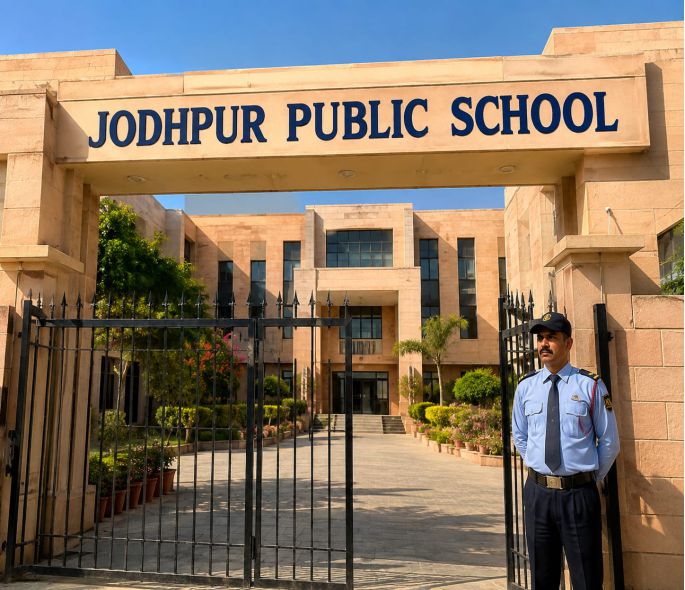
Why Schools Need Trained Security Personnel
Why Schools Need Trained Security Personnel in Rajasthan Protecting Students, Teachers and School Campuses Through Professional Security Schools are places where children spend a significant part of their day learning, developing and participating in activities. A safe educational environment is therefore not simply a facility-management requirement—it is an essential part of effective education. With schools across Jodhpur, Jaipur, Udaipur, Kota, Ajmer, Bikaner, Alwar, Bhilwara, Pali and other cities of Rajasthan continuing to grow, school management needs to look at security as a comprehensive responsibility. Modern school security is not limited to placing a guard at the main gate. A professionally designed school-security programme should protect: Students + Teachers + Staff + Visitors + Campus + Assets + Information + School Reputation A comprehensive protection philosophy can be applied through: Prevent → Deter → Detect → Respond → Recover → Improve This is why schools should consider trained security personnel supported by appropriate technology, SOPs, supervision and emergency preparedness. Why School Security Is Different from Other Security Requirements A school is different from a factory, warehouse or commercial building. Schools have: Children and young students Teachers and academic staff Administrative personnel Parents and guardians School buses Visitors Contractors Vendors Sports facilities Laboratories Libraries Playgrounds Events and assemblies Security personnel must therefore be trained to maintain security without creating an intimidating environment for students. The emphasis should be on: Safety + Prevention + Discipline + Communication + Child-Sensitive Behaviour Top Reasons Schools Need Trained Security Personnel Controlled Entry and Exit The school gate is the first and most important layer of physical security. Every day, hundreds or even thousands of people may enter and leave a school campus. Potential risks include: Unauthorized entry Unidentified visitors Unauthorised access to restricted areas Students leaving campus without authorization Uncontrolled contractor movement Entry of unauthorized vehicles Solution Trained security personnel should manage: Main-gate access Student entry and exit procedures Staff identification Visitor registration Visitor passes Contractor access Delivery personnel Vehicle movement Parent/guardian access according to school policy Security staff should always follow the school’s approved procedures rather than making informal decisions. Visitor Management Schools receive many visitors, including: Parents Guardians Vendors Delivery personnel Maintenance teams Government officials Service providers Guests Without proper visitor management, school management may not know who is inside the campus. Recommended Visitor-Control System A professional school security system should include: Identification → Verification → Authorization → Visitor Registration → Controlled Movement → Exit Record Where appropriate, visitors should be provided with identification or visitor passes and directed only to authorized areas. Sensitive areas should not be freely accessible to visitors. Protection of Students During Arrival and Departure The beginning and end of the school day can create significant movement around the campus. Large numbers of: Students Parents School buses Vans Cars Two-wheelers Staff members may converge at the same time. Trained security personnel can help manage: Gate congestion Pedestrian movement Vehicle movement School-bus access Parent/guardian entry Unauthorized access Emergency vehicle access Security personnel should coordinate with school administration and transport staff to maintain orderly movement. Child-Sensitive Security School security requires a different approach from ordinary commercial security. Security personnel should understand that students are children and young people who may require assistance, reassurance or clear communication. Security staff should be trained in: Appropriate communication with students Professional conduct Maintaining boundaries Reporting concerns to school management Emergency assistance Lost-child procedures Crowd management De-escalation Respectful behaviour Security personnel should never take disciplinary action against students beyond their authorized duties. Any behavioural or safeguarding concern should be immediately escalated to the designated school authority. CCTV Surveillance and Security Monitoring CCTV can significantly strengthen a school’s security system when properly designed and monitored. Appropriate coverage may include: Main gates Entry/exit points Parking areas Perimeter Reception Corridors Common areas Sports facilities Storage areas Other security-sensitive locations Important Principle CCTV should complement—not replace—trained security personnel. A guard can identify unusual behaviour, communicate with school staff and respond according to established procedures, while CCTV provides additional surveillance capability. Cameras should be positioned with careful consideration of student privacy and applicable laws/policies, and should not be installed in areas where privacy is expected. School Perimeter Security Schools may have large campuses containing: Buildings Playgrounds Sports grounds Parking areas Gardens Storage facilities Boundary walls Unmonitored perimeter areas can create vulnerabilities. Recommended Measures Secure boundary walls and gates Adequate lighting Regular patrols CCTV where appropriate Controlled access points Periodic security inspections Identification of vulnerable areas Security supervisors should conduct regular checks and report damaged fencing, gates, lighting or other security weaknesses. Emergency and Evacuation Preparedness A school security team must be prepared for emergencies. Potential emergencies may include: Fire Medical emergencies Natural events Electrical incidents Security incidents Severe weather Evacuation situations Trained security personnel should understand: Emergency alarm procedures Evacuation routes Assembly points Emergency communication Access for emergency responders Gate-opening procedures Crowd management Incident escalation Regular drills can help staff and students become familiar with emergency procedures. Fire Safety and Life Safety Support Fire safety is particularly important in educational institutions because schools may contain large numbers of students in classrooms, laboratories, libraries, halls and other areas. A comprehensive school safety programme should include appropriate: Fire detection Fire alarms Fire extinguishing equipment Emergency exits Evacuation routes Emergency lighting Assembly points Fire drills Emergency communication Security personnel should know the location of emergency exits and fire-safety equipment and understand their role during an evacuation. Fire systems and evacuation arrangements should be designed and maintained according to applicable fire-safety and building requirements. Protection Against Theft and Property Loss Schools contain valuable assets such as: Computers Smart boards Projectors Laboratory equipment Sports equipment Books Furniture Electrical equipment Documents Security personnel can help protect school property through: Gate control Visitor management Material movement control Patrols CCTV monitoring support Lock-and-key control Incident reporting Material leaving the campus should be handled according to the school’s authorization procedure. Professional Supervision and SOP Compliance Simply hiring guards does not create an effective school-security system. Security personnel require: Defined duties Post orders Shift handover procedures Visitor-management SOPs Gate-control