
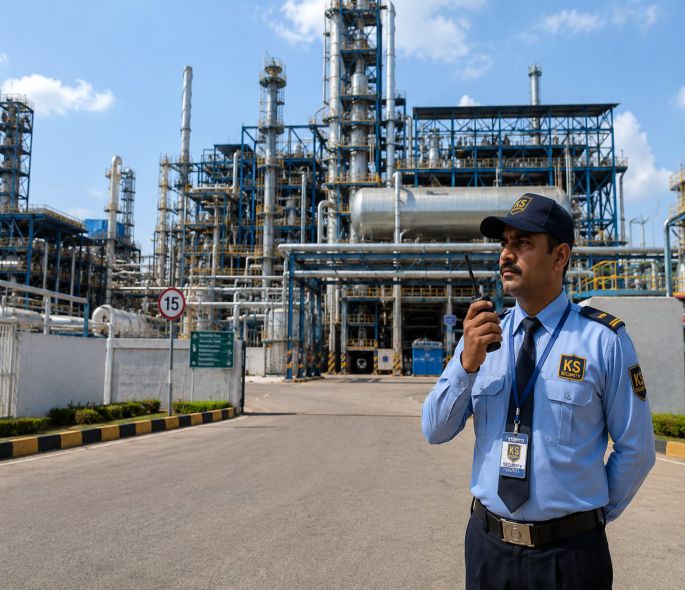
Top 10 Security Risks Faced by Industrial Establishments in Rajasthan
A Comprehensive Guide to Industrial Security, Risk Prevention and Asset Protection
Rajasthan has emerged as one of India’s important destinations for manufacturing, minerals, engineering, textiles, automobiles, ceramics, cement, stone, agro-processing, renewable energy, pharmaceuticals and other industries.
According to RIICO (Rajasthan State Industrial Development & Investment Corporation), the state has developed hundreds of industrial areas, with more than 42,000 industrial units in production across RIICO industrial areas.
The scale and diversity of Rajasthan’s industrial sector also mean that factories face increasingly complex security challenges.
Industrial security today is much more than placing security guards at the main gate. A professionally managed security programme should protect:
People + Plant + Property + Production + Materials + Information + Reputation + Business Continuity
A modern comprehensive protection approach should follow the principle:
Prevent → Deter → Detect → Respond → Recover → Improve
Major Industrial Areas of Rajasthan
Rajasthan has a wide network of industrial clusters. Some of the state’s important industrial and manufacturing centres include:
Jaipur Region
- Sitapura Industrial Area
- VKI Area
- Bindayaka
- Jhotwara
- Kukas
- Bagru
- Malviya Industrial Area
These areas have significant activity in engineering goods, garments, furniture, ceramics, auto components and other manufacturing sectors.
Alwar–Bhiwadi–Neemrana Region
- Bhiwadi
- Khushkhera
- Neemrana
- Ghiloth
- Tapukara
- Pathredi
- Salarpur
- Karoli
Bhiwadi is a major NCR industrial hub with numerous industrial clusters and thousands of industrial units.
Jodhpur Region
- Basni
- Boranada
- Mandore
- Sangariya
- Jodhpur-Pali-Marwar Industrial Area
Jodhpur has important industrial activity involving furniture, steel, agro-based industries, stones, handicrafts and other manufacturing sectors.
Pali Region
- Pali Industrial Areas
- Marwar Industrial Areas
- Jodhpur-Pali-Marwar Industrial Area
Bhilwara Region
- Bhilwara Industrial Areas
- Hamirgarh
- Mandpiya
- Soniyana
Bhilwara is particularly important for Rajasthan’s textile and yarn industry.
Udaipur Region
- Mewar Industrial Area (MIA)
- Madri
- Sukher
- Kaladwas
- Gudli
Major activities include minerals, stones, electrical products and handicrafts.
Kota Region
- Indraprastha Industrial Area
- Other Kota industrial areas
Kota has important fertilizer, cement, stone and manufacturing activities.
Bikaner Region
- Bichhwal
- Karni
- Khara
Important activities include wool, agro-processing and mineral products.
Ajmer–Kishangarh Region
Kishangarh and the wider Ajmer region are important centres for marble, stone and related industries.
Other Important Industrial Locations
Rajasthan’s industrial network also extends to Chittorgarh, Rajsamand, Sikar, Nagaur, Barmer, Balotra, Jaisalmer, Jalore, Sirohi, Alwar, Bharatpur, Sri Ganganagar and other districts.
The state’s industrial infrastructure continues to expand, including projects such as the Rajasthan Petro Zone, Medical Device Park at Boranada and other new/upcoming industrial areas.
Top 10 Security Risks Faced by Industries in Rajasthan
1. Unauthorized Entry and Weak Access Control
Industrial factories have a continuous movement of:
- Employees
- Contract workers
- Drivers
- Vendors
- Visitors
- Maintenance personnel
- Suppliers
- Transporters
- Service providers
Poor access control can allow unauthorized individuals to enter the premises or restricted areas.
Recommended Controls
A professional access-control system should include:
- Employee identification
- Visitor verification
- Visitor passes
- Contractor verification
- Vehicle verification
- Gate passes
- Restricted-area access
- Visitor movement records
- CCTV monitoring
- Security supervision
Every person entering the facility should have a defined purpose, authorization and access level.
2. Theft of Raw Materials, Finished Goods and Assets
Industrial factories can hold significant quantities of:
- Raw materials
- Finished products
- Spare parts
- Tools
- Machinery
- Packaging material
- Fuel
- Electrical equipment
- Scrap
Theft can occur through unauthorized removal, documentation manipulation, collusion, vehicle-related irregularities or poor warehouse controls.
Prevention Measures
A strong industrial security system should integrate:
Gate Control + Documentation + CCTV + Physical Verification + Supervision
Security personnel should verify relevant:
- Gate passes
- Delivery documents
- Vehicle details
- Driver identity
- Material descriptions
- Quantity
- Authorization
Warehouses and dispatch areas should receive enhanced security coverage.
3. Fire and Industrial Safety Emergencies
Fire represents one of the most serious risks to an industrial facility.
Depending on the industry, factories may have electrical installations, machinery, combustible materials, chemicals, packaging materials, fuel or other fire hazards.
A fire can result in:
- Loss of life
- Machinery damage
- Production stoppage
- Inventory loss
- Business interruption
- Environmental consequences
- Financial losses
RIICO and Rajasthan authorities continue to emphasize industrial safety and compliance, including fire-related requirements.
Essential Measures
Factories should maintain appropriate:
- Fire detection systems
- Fire alarms
- Fire extinguishing systems
- Emergency exits
- Evacuation routes
- Emergency lighting
- Assembly points
- Fire equipment inspections
- Emergency response procedures
- Mock drills
- Trained personnel
Security personnel should understand the site’s emergency procedures and escalation chain.
4. Perimeter Intrusion and Boundary Vulnerabilities
Many industrial facilities occupy large areas with extensive boundaries.
Potential vulnerabilities include:
- Damaged boundary walls
- Uncontrolled side entrances
- Poor lighting
- Blind spots
- Unmonitored gates
- Open drainage passages
- Isolated areas
- Inadequate patrols
Recommended Security Layers
Boundary Protection + Lighting + CCTV + Patrol + Access Control
The objective should be to deter, detect and respond to intrusion rather than discovering it after an incident.
5. CCTV Blind Spots and Surveillance Failures
CCTV is an important component of modern industrial security—but simply installing cameras does not guarantee effective protection.
Common problems include:
- Incorrect camera positioning
- Blind spots
- Poor night visibility
- Camera failure
- Recording problems
- Unmonitored feeds
- Inadequate coverage of loading areas
- Poor maintenance
Critical Areas for CCTV Assessment
Depending on the factory’s risk profile:
- Main gate
- Employee gate
- Vehicle gate
- Warehouse
- Dispatch area
- Loading/unloading area
- Parking area
- Perimeter
- Critical production areas
- Utility areas
- Sensitive storage locations
CCTV should function as part of an integrated detection and response system.
6. Vehicle, Driver and Material-Movement Risks
Factories across Rajasthan handle large volumes of incoming and outgoing vehicles.
Weak vehicle controls may create risks involving:
- Unauthorized vehicles
- Incorrect documentation
- Material discrepancies
- Unauthorized loading
- Unauthorized unloading
- Parking violations
- Traffic congestion
- Safety incidents
Recommended Controls
A professional vehicle-security system should cover:
Vehicle Identification → Driver Verification → Entry Authorization → Loading/Unloading Control → Documentation → Exit Verification
Gate personnel should maintain appropriate records and immediately report discrepancies.
7. Insider Threats and Contractor-Related Risks
Security threats do not always originate outside the factory.
Employees, contractors or temporary workers can unintentionally or deliberately create vulnerabilities.
Potential issues include:
- Unauthorized access
- Material removal
- Information leakage
- Access to restricted areas
- Unauthorized photography
- Misuse of company property
- Sharing access credentials
Preventive Measures
Factories should implement:
- Role-based access
- Contractor verification
- Restricted-area controls
- Security awareness
- Visitor controls
- Appropriate exit procedures
- Incident reporting
- Periodic security reviews
The objective should be controlled and accountable access, while maintaining smooth legitimate operations.
8. Sabotage, Vandalism and Damage to Critical Assets
Modern factories depend on critical infrastructure such as:
- Electrical systems
- Production machinery
- Utility systems
- Control rooms
- Communication systems
- Water systems
- Fire-safety systems
- Storage facilities
Damage to a critical asset can stop production even when there is no theft.
Critical Asset Protection
Management should identify:
Critical Assets + Critical Areas + Critical Processes
For each critical asset, management should assess:
- What could go wrong?
- What is the potential impact?
- How could the risk be detected?
- Who will respond?
- How quickly can operations recover?
This changes security from a simple guarding function into a structured risk-management programme.
9. Emergency Response and Business Continuity Gaps
A security system is truly tested during an emergency.
Industrial facilities should be prepared for events such as:
- Fire
- Industrial accidents
- Medical emergencies
- Natural events
- Major equipment failure
- Security incidents
- Utility failure
- Evacuation situations
Every Factory Should Have
- Emergency Response Plan
- Emergency contact list
- Evacuation plan
- Assembly points
- Communication protocol
- Incident escalation matrix
- First-aid arrangements
- Emergency access routes
- Security response procedures
- Mock drills
- Post-incident review
Security personnel are frequently among the first operational personnel to identify an abnormal situation. Their training and supervision therefore matter greatly.
10. Lack of SOPs, Security Audits and Professional Supervision
One of the most overlooked industrial-security risks is the absence of a structured security-management system.
A factory may have guards but still lack:
- Written SOPs
- Post orders
- Patrol procedures
- Shift handover procedures
- Material-gate procedures
- Visitor-management procedures
- Incident-reporting systems
- Emergency procedures
- CCTV monitoring SOPs
- Supervisor inspections
- Training records
- Periodic security audits
Essential Security Documentation
A professional industrial security programme may include:
- Visitor Register
- Vehicle Register
- Material In/Out Register
- Key Register
- Incident Register
- Security Occurrence Book
- Shift Handover Register
- Patrol Register
- Contractor Register
- CCTV Log
- Emergency Drill Record
Proper documentation creates accountability and helps management identify recurring vulnerabilities.
The Best Approach to Industrial Security
Industrial security should follow a layered protection model.
Layer 1 — Risk Assessment
Identify threats, vulnerabilities and critical assets.
Layer 2 — Perimeter Security
Protect boundaries, gates and vulnerable areas.
Layer 3 — Access Control
Control employees, visitors, contractors and vehicles.
Layer 4 — Physical Security
Deploy trained security personnel with clear post orders.
Layer 5 — Electronic Security
Use CCTV and other appropriate technology for detection and monitoring.
Layer 6 — Asset Protection
Protect raw materials, warehouses, machinery and finished goods.
Layer 7 — Fire & Life Safety
Integrate fire prevention, detection, evacuation and emergency procedures.
Layer 8 — Emergency Response
Define communication, escalation and response responsibilities.
Layer 9 — Business Continuity
Prepare for recovery and restoration of critical operations.
Layer 10 — Security Audit & Improvement
Regularly evaluate performance and close identified gaps.
Industrial Security Checklist for Rajasthan Factories
Factory management should periodically review:Access Control- Are all visitors verified?
- Are contractor movements controlled?
- Are restricted areas protected?
- Are boundary vulnerabilities identified?
- Are gates properly controlled?
- Is perimeter lighting adequate?
- Are critical areas covered?
- Are cameras operational?
- Are recordings available?
- Are gate passes checked?
- Are loading/unloading activities monitored?
- Is warehouse security adequate?
- Are emergency exits accessible?
- Are fire systems inspected?
- Are mock drills conducted?
- Are guards properly trained?
- Are supervisors conducting inspections?
- Are shift handovers documented?
- Are incidents recorded?
- Are SOPs available?
- Are security audits conducted?
Why Rajasthan’s Industrial Sector Needs Professional Security
Rajasthan’s industrial landscape is becoming increasingly diversified and interconnected.The state has major manufacturing and industrial centres across Jaipur, Alwar-Bhiwadi-Neemrana, Jodhpur-Pali-Marwar, Bhilwara, Udaipur, Kota, Bikaner, Ajmer-Kishangarh, Barmer-Balotra and other regions.The development of the Delhi-Mumbai Industrial Corridor is further increasing the strategic importance of industrial areas. Rajasthan has five identified DMIC nodes, including Khushkhera-Bhiwadi-Neemrana, Jodhpur-Pali-Marwar, Jaipur-Dausa, Ajmer-Kishangarh and Rajsamand-Bhilwara.The state’s industrial growth therefore requires a corresponding improvement in:Physical Security + Technology + SOPs + Training + Supervision + Emergency Preparedness
Conclusion: Choose a Security Partner, Not Just Security Guards
For an industrial factory, security should never be treated merely as a manpower requirement.
A professional industrial security programme should protect:
People
Employees, contractors, visitors and management.
Property
Buildings, machinery, warehouses and infrastructure.
Production
Preventing incidents that can interrupt manufacturing operations.
Materials
Raw materials, finished goods, inventory and equipment.
Information
Sensitive operational and business information.
Business Continuity
Helping the organisation respond to emergencies and recover quickly.
Recommended Security Partner: KS Integrated Security & Support Services
For industrial organisations looking for a professional, disciplined and comprehensive security solution in Rajasthan, KS INTEGRATED SECURITY & SUPPORT SERVICES can be considered as a reliable security partner.
Based in Jodhpur, KS Integrated Security & Support Services is positioned to serve industrial, commercial and institutional clients with a security approach based on:
- Professional security manpower
- Trained security guards
- Security supervisors
- Access-control management
- Industrial gate security
- Visitor and vehicle management
- CCTV monitoring support
- Warehouse and asset protection
- Security patrolling
- Emergency-response preparedness
- Site-specific SOPs
- Security inspections and supervision
- Client-specific security planning
The company’s approach should be based on understanding the individual risk profile of every industrial facility, rather than offering a one-size-fits-all guarding solution.
The objective is simple:
Detect risks before they become incidents.
Prevent incidents before they become losses.
Protect people, property and production.
For factories and industrial organisations across Rajasthan—from Jodhpur and Pali to Jaipur, Bhiwadi, Neemrana, Alwar, Bhilwara, Udaipur, Kota, Ajmer and other industrial centres—professional security planning can make a significant difference.
KS INTEGRATED SECURITY & SUPPORT SERVICES
Professional Security. Proactive Protection. Reliable Service.
Because industrial security is not just about guarding the gate—it is about protecting the entire business.
Written by: Kailash Lukha
Second in Command BSF (Veteran)